Scents and Sensibility: The Science Behind Smell
In almost all animals the sense of smell is vital to find food, detect danger and identify family members. For example, sharks and other fish have nostrils that allow them to smell underwater even though they have gills and mouths to breathe through. Smell is an important sense used in our daily life but how does it work in humans? How do we smell different foods, drinks, fragrances or good/ bad odors?
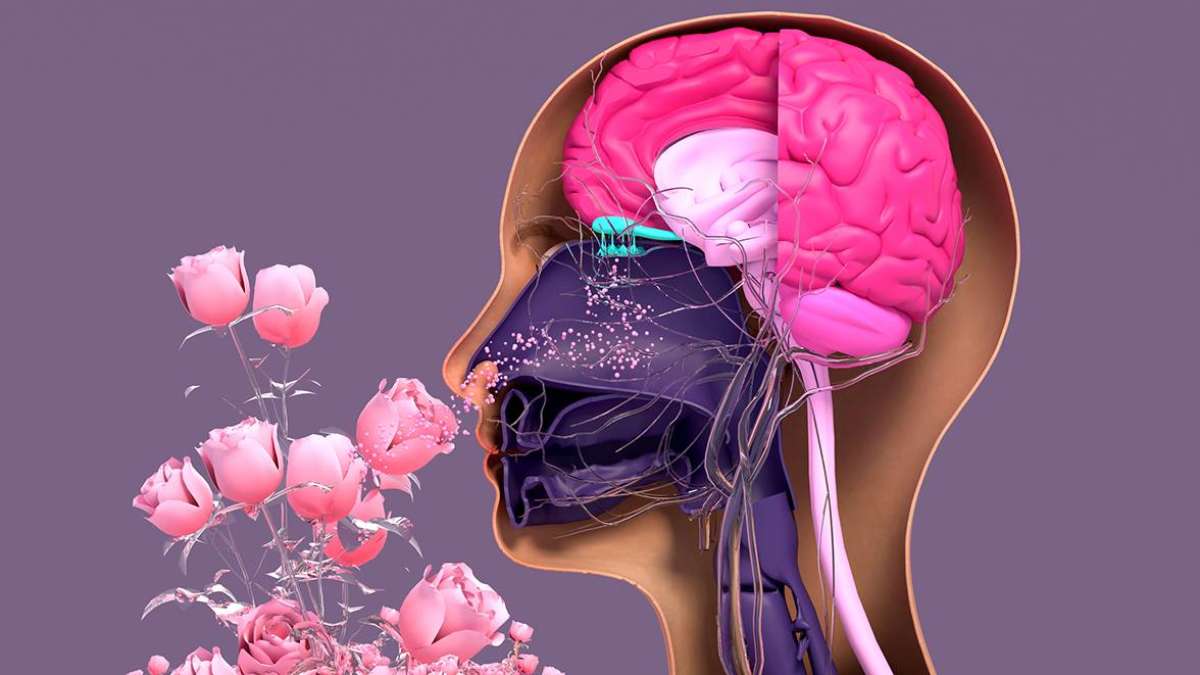
Smell is a chemical sense that involves the detection of airborne molecules using around 400 receptors in the nose, each with their own distinct function. The scents we can detect and identify are made up of a mixture of many different odor molecules that are very volatile and therefore evaporate easily. Each of these odor molecules can bind to the receptors in the nose, an action that explains how smell works.
When you smell an odor, tiny molecules enter your system. Their binding to receptors stimulate specialized nerve cells in the roof of the nose called olfactory sensory neurons to send electrical messages through a cable-like connection of many neurons to an area called the olfactory bulb in the front of the brain. Each olfactory neuron in the olfactory bulb connects with a different neuron which then sends messages to different parts of the brain helping us recognize odors.
Smells often bring back old memories. Why? This is because some of the parts of the brain that receive messages from the olfactory bulb store memories or provoke emotions allowing smells to help us reconnect with old experiences.
The scents we smell on a daily basis are composed of many different odor molecules. For example the scent of a cup of coffee is made from more than 800 odor molecules. While, when odor molecules are used alone they present regular coding patterns that we talked about above, when two or three odors are mixed together the nerve cell responses are more complex in nature. One odor can alter the nerve cell response to other odors even if the first odor did not stimulate any response in the cell when delivered alone. This either enhances or suppresses the strength of the effect of the neurons preferred odor. Therefore the codes sent to the brain for a mixture of odors is different from what would be predicted from the addition of each odors normal nerve signal response. Therefore, by challenging the way cells respond to different odor molecules, scent molecules can mask other scents. However, scientists have long found it challenging to understand how the nose and brain collaborate to distinguish individual odors within complex scent mixtures.These findings help us understand why humans struggle to find the individual odors in a mixture, helping us find ways to train ourselves to smell better even if we cannot decode smell mixtures.
These findings about our sense of smell help explain why illnesses like Alzheimer’s, the flu, or COVID-19 can lead to losing this important sense. Understanding this connection makes it even more important to keep exploring the topic, as it could not only give us better insights into these conditions but also help with earlier diagnoses and finding new treatments.

Citations:
- Making Sense of Scents – UCSF
- How the Nose Decodes Complex Odors – NIH
- How Do We Smell Things? – Queensland Brain Institute
Picture Credits:

Author: Dheera Vandini Mehendiratta